The surest way to improve your own life is to improve the world you live it in. Helping others is not charity paid against your interest — it is your interest, compounding. The book calls that selfish altruism, and it is the entire price of admission.
Citizenship is not a membership, a registration, or agreement with every proposal in the book. A citizen of civilization is anyone who shares the common ground — one argument, built from three assumptions you already hold, and the six values that fall out of it. Audit it. If you cannot fault it, you are already standing on it.
Part I asks for one thing and offers everything else. It makes a single argument, follows it where consistency forces it, states the rule it holds itself to, and names the six values that fall out.
Ground : Permanent and shared — sharing it is what makes someone a citizen
Almost everything that makes your life livable was built by strangers: the language you think in, the medicine that kept you alive, the roads and the wires. The richest man of 1900 could not buy an antibiotic at any price; you can, because in the years between, other people solved problems. Every problem someone else solves is one you never face, and every mind that gets the chance to work is a chance at the discovery that saves your life. That is why improving the world is not a tax on your own effort — it multiplies what your effort earns. The book calls this selfish altruism and checks it at three scales: a village of farms, a neighbourhood buying firewood together, and the Marshall Plan, which was sold as cheaper than the alternative and never as charity. Trading goods grows a society step by step; sharing what it learns makes it compound, because a loaf shared is halved but an idea shared is doubled.
EvidenceThe richest man alive in 1900 could not buy an antibiotic, a transatlantic phone call, or air conditioning at any price.+
What supports it
Sulfonamide antibacterials reached clinical use in 1935 and penicillin in the early 1940s. The first transatlantic telephone service (radio-based) opened in 1927 and the first cable service in 1956. Willis Carrier's electrical air conditioning dates to 1902, with residential installations following in the 1910s.
What is inference
None. The dates are documented. The only softness is that air conditioning arrives two years after 1900 — the sentence is true as written and would be false if it said 1905.
What would weaken it
A documented pre-1900 clinical antibacterial, transoceanic voice link, or mechanical domestic cooling system available for purchase.
Sources
SecondaryFleming, Chain, Florey — Nobel Prize in Physiology or Medicine 1945Nobel Foundation, prize citation and lectures, 1945
SecondaryWillis H. Carrier, "Apparatus for Treating Air"US Patent 808,897, filed 1904, granted 1906; first system installed 1902
Last reviewed September 6, 2026
EvidenceThe Marshall Plan was sold as self-interest — cheaper than the alternative — not as charity.+
What supports it
The European Recovery Program disbursed roughly $13 billion between 1948 and 1952. Marshall's 1947 Harvard address framed it as directed "against hunger, poverty, desperation and chaos," and the Truman administration argued it to Congress on containment and trade grounds. The framing as self-interest is documented in the primary record.
What is inference
The book's stronger reading — that the plan caused the recovery and so proves cooperation pays — is the part that is argued. Historians disagree on the size of the economic effect: some credit institutions and confidence more than the money itself; others find the direct contribution modest against Europe's own output.
What would weaken it
Evidence that the funded economies would have recovered as fast without the program, or that the program was in fact argued to Congress primarily as charity.
Sources
PrimaryGeorge C. Marshall, address at Harvard University5 June 1947, Department of State Bulletin
SecondaryDeLong & Eichengreen, "The Marshall Plan: History's Most Successful Structural Adjustment Program"NBER Working Paper 3899, 1991
SecondaryAlan Milward, The Reconstruction of Western Europe 1945–51Methuen, 1984 — the skeptical reading
Last reviewed September 6, 2026
EvidenceAfghanistan's decades of collapse cost the world many times what its stabilization would have cost.+
What supports it
The Costs of War project at Brown University estimates US spending on the Afghanistan and Pakistan war zone at roughly $2.3 trillion through 2021, before interest and veterans' care. Aid and reconstruction spending across the same period was a small fraction of that.
What is inference
The counterfactual — what an earlier stabilization would have cost, and whether it would have worked — is inference. The cost of the collapse is documented; the cost of the road not taken is an estimate the book is making, and it should be read as one.
What would weaken it
A credible estimate that earlier stabilization would have cost as much as the war did, or evidence that stabilization was attempted at scale and failed for reasons money could not fix.
Sources
PrimaryCosts of War project, "U.S. Costs to Date for the War in Afghanistan"Watson Institute, Brown University, 2021
PrimarySpecial Inspector General for Afghanistan Reconstruction, "What We Need to Learn"SIGAR lessons-learned report, August 2021
Ground : Permanent and shared — sharing it is what makes someone a citizen
Good is a direction, not a destination: away from the worst possible suffering of everything that can suffer. It is stated as a direction on purpose. "Maximise happiness" is not the same thing in reverse — pain scales up without limit and pleasure does not; pushed past its point the feast becomes nausea — so moving away from suffering is a stable heading, while marching toward maximum happiness walks off a cliff carrying a banner. It is also why Athens could invent democracy and still keep slaves, and why the future will find our blind spots as easily as we find theirs. Where does the direction come from, if no instrument can read the purpose of the universe? From something you already do: you pull your hand off a hot stove without being argued into it, so your conduct concedes a hundred times a day that your own suffering matters. Then name what makes yours special — intelligence, nationality, effort, faith? Each is either shared by others or an accident that fell to you, so anyone on earth can claim the exception with exactly as much force as you can, which is none. One exit is left open: "nothing matters, mine to me and yours to you." The book does not lock it; it prices it. Whoever takes it has given up every claim of unfairness in advance, and nobody stays there past the first time someone steps on their foot.
Ground : Permanent and shared — sharing it is what makes someone a citizen
You cannot reach a goal with a false map. The last chapter set a direction, and steering toward it is only as good as the chart you steer by, so this chapter sets the rule for the chart: nothing on this ground may require faith. Beliefs are held as probabilities and change when the facts change — the culture calls that flip-flopping; this ground calls it the only kind of belief you can stand on, because a belief that cannot move has confessed something about itself. The test for which kind you are holding: imagine it erased. Burn every chemistry book and chemistry comes back, because it was stored in the world, not the books. Erase a holy text and whatever returns is a different text, which is why the world holds thousands of scriptures and one chemistry. The book applies the test to itself: erase this framework and the same ground should re-form, because humans and their needs are still here, and if that is false the framework deserves to stay erased. It also names dogma by sight — a belief so fused to identity that examining it feels like destroying yourself — and warns that it is a human default, most often political today.
“A loaf shared is halved, but an idea shared is doubled.”
The Six Values
Ground : Permanent and shared — sharing it is what makes someone a citizen Read
Point the direction at the parts of a life — minds, bodies, work, rules, and force — and six values fall out. Most will read as common sense, which is the point: common sense has never had a written ground to stand on. Each is given with the reason it follows and with what it does not claim, because values are misread more often than they are rejected. Tap to open.
IEquality+
"No one is special" was the engine of the definition of good; equality is that engine applied to groups. Advantage or disadvantage handed out by group membership is the same special pleading, wearing a uniform. The selfish case is as strong as the fair one: talent appears everywhere and opportunity does not, so every mind denied its chance is a treatment undiscovered or a repair unmade that you will now go without. Discrimination is a civilization burning its own library, unread.
Does not claim: sameness of outcome. People differ in effort, in judgment, and in what they want from a life. Equality means removing group-granted advantage and disadvantage and keeping opportunity open; what people build from an open field will differ, and must be allowed to.
IIEducation+
Cooperation between strangers runs on two fuels: minds able to solve problems, and a shared floor of agreed fact, without which no trade or negotiation is possible. Education produces both. The antibiotic the richest man of 1900 could not buy exists because minds were taught, freed, and pointed at problems. Every person a society fails to teach is a bet placed against its own future, and the future sends the bill.
Does not claim: that schooling and credentials are the value. Institutions are one implementation, judged by what they produce. The value is the capacity itself — a population able to learn, verify, and think past what it was handed.
IIIHealthcare+
Anyone can become sick. No achievement exempts you and no plan survives a diagnosis, which makes this one of the most invariant facts a value can stand on. A society where illness means ruin is one where every person, however careful, lives one accident from the edge — and the sick who cannot recover stop contributing, so the loss spreads to everyone through the same connections that carry the gains. The healthy are simply the sick of a later date, negotiating their future terms.
Does not claim: any particular system. Single-payer, multi-payer, how funded, how governed — many-factor questions the book leaves to the vote.
IVBottom-Built Economy+
An economy is the firewood neighbourhood at the scale of millions, running on the same running total of contribution against extraction. It is measured at its floor for a practical reason before a kind one: a person struggling to survive cannot think past surviving. Survival stress consumes exactly the faculties contribution needs — judgment, patience, foresight — and desperate people make desperate neighbours, whose desperation becomes everyone's cost in a hundred forms. A strong floor is not softness. It is infrastructure, like roads, and everyone's traffic moves better for it.
Does not claim: leveling. The floor is a floor, not a ceiling — merit still rewarded, wealth still possible, and the farmer who made the discovery still lives better than anyone before. Between the floor and the sky, build.
VEqual Law+
The whole function of law is to let strangers rely on each other, and exceptions are exactly what destroy reliance. In any society where the powerful are tried differently, or not at all, people learn arithmetic rather than obedience: why cooperate with rules that are prices for the poor and suggestions for the rich? The law's authority is not stored in its punishments; it is stored in its sameness, and it spends down every time an exception is made.
Does not claim: harshness. Identical application is not merciless application — a law can be humane and equal, provided it is humane to everyone. Nor does the value say how law should be written or judged; that is a worked system in Part Four.
VIViolence Is Failing+
If suffering is bad, deliberately causing it can never count as a success — at best it is a cost paid because no better way was found in time. Sometimes none existed; this is not pacifism, and the wolf will not negotiate. But the wording is deliberate. Not violence is wrong, a simple rule that breaks on the first hard case, but violence is failing to find a better way: a verdict that stays attached to the act even when the act was justified. The soldier can be right and the war still a failure. Keeping the verdict attached is what keeps a civilization looking for better ways, and the looking is the duty.
Does not claim: that defense is illegitimate, or that all violence is equal. A society that cannot protect its people fails them by other means. The claim is about what violence is — never an achievement, always a sign that something better was not found — and the obligation that follows: keep looking.
Not everything in the book carries the same weight, and the book says so. Its claims are sorted into three spaces by one test: could the facts force this conclusion, or only justify it? The badges on the summaries below show which space each belongs to.
Ground : Permanent and shared — sharing it is what makes someone a citizen
The Ground
Conclusions built on facts that do not move — beings suffer, no one is special, cooperation compounds, anyone can become sick, rules bind everyone or they do not. They were true in Athens and will be true anywhere the book is read, so the conclusions do not move either. Permanent and shared.
Sharing the ground is the whole of what makes someone a citizen — not a party, a policy, or a creed.
Extension : Argued for, never demanded — disagreeing costs no one their citizenship
The Extension
Where the values point when applied to the real world: what law should look like, what the floor of an economy rests on, how a society should decide. These depend on inputs that vary by place, time, and technology, so they are stated as relationships and can only be argued for — demanding agreement with something you cannot yet verify would be faith, which the ground forbids. Argued for, never demanded.
Disagreeing with any of it costs no one their citizenship.
Implementation : A candidate, never a conclusion — owned by the vote
The Implementations
The actual designs and the numbers inside them — a voting system with its thresholds, a tax rate, the level of the floor. The facts justify these without compelling them; each is one candidate among others that could meet the same requirement. Owned by the vote, because only a whole population weighing all the factors at once can set them, and no philosopher or expert may.
Part II
The Method
Is giving a poor addict some money a good thing to do? "Always" eventually funds a fatal dose; "never" walks past someone who would have bought bread; "give food instead" assumes you know their situation better than they do. Every simple answer is wrong somewhere, and accepting that is the whole thesis of Part Two: good is a simple idea and a complicated application, so a mind that wants any real chance at its goals needs a view as complex as the situation. The book calls the philosophy complex simplicity, because that is how the universe itself is built — stone, ant colony, body, and civilization are each simple parts stacked into something no part understands. The catch is that your senses were built by the same cheap process and report a sketch, not the world. So the method has to outrun the instrument, and the method is existential awareness: the situational awareness pilots are trained in, expanded to everything that produced the situation, touches it, or will be moved by it.
Take in the environment and the elements in it: what is known, what can be influenced, and — honestly — what may be unknown. The driver who is surprised by brake lights and the driver who saw the traffic tightening three cars ahead differ at this step.
2
Understand
Work out how the elements relate to each other, because things connect. A moon launch is thrust against weight and gravity against trajectory; making dinner is heat against time. They are the same three steps at different degrees, which is why the method scales to anything.
3
Balance
Weigh the elements and their relationships toward the outcome you want. This is not a standard you meet but a scale you climb, running from oblivious at one end to comprehending every interaction in the universe at the other. No one reaches the far end; the method is just climbing on purpose.
Balance is not the middle
Kant held that you must never lie, even to a murderer asking where your friend is hiding; the opposite shortcut, do whatever is best for the most, ends with a surgeon harvesting one patient to save five. Both fail because one rule was asked to leave its situation and govern all the others. So the book runs morals as weighted scales — but weighing is not splitting the difference, which is only a shortcut wearing balance's clothes. Sleep sits in a narrow range, exercise in a wide one, and some situations are genuinely one-sided, so the balanced response to them is one-sided too.
Certainty is not required to act
Most things sit on a spectrum, and the best point on the spectrum is often unknowable — but the usable sections are not. No one can prove the perfect speed limit for a road, and everyone can identify speeds clearly too fast for safety and clearly too slow for function, which is enough to set a defensible range and adjust it. Waiting for the exact point is a way of never moving.
Find the ultimate cause
The primary cause of a plane falling is that lift stopped exceeding drag — true, and useless. The ultimate cause is that it ran out of fuel, and only that answer prevents the next crash. The same trap catches weight loss: more calories in than out is true and nearly useless, because the body is a system that answers back and cuts spending when income falls. Every real explanation is a list of factors, each as wrong as it is right the moment it ignores the others.
Small factors aggregate
For most of a century British track cycling won almost nothing. Then a new director, instead of hunting one marvellous improvement, found every factor that touches a rider and improved each by a margin too small to brag about — down to the pillow that travelled with each rider so sleep stayed constant. Eight golds in one Olympics. Small factors are only small one at a time, and they also loop: a century of putting out every small forest fire banks a continent of fuel for one that cannot be fought.
EvidenceBritish cycling won almost nothing for a century, then improved every small factor and won eight golds in one Olympics.+
What supports it
Great Britain won one Olympic cycling gold between 1908 and 1992. At Beijing 2008 the team won eight of the ten track cycling golds and fourteen cycling medals in total. Performance director Dave Brailsford publicly attributed the turnaround to "the aggregation of marginal gains."
What is inference
That marginal gains caused the result is the argued part. National Lottery funding from 1997, talent identification, and full-time coaching arrived in the same decade; disentangling their contributions from the small-factor philosophy is not possible from the public record. The book uses the story as an illustration of the principle, not as proof of it.
What would weaken it
Evidence that the medal haul tracks funding and athlete pool size closely enough that the marginal-gains programme added nothing measurable.
SecondaryDave Brailsford interviews on marginal gainsBBC Sport, 2012
Last reviewed September 6, 2026
Many factors, one balance.
Part III
The Path
Part Three is the practical part, and it asks for no prior agreement with anything else in the book. It is one movement outward in three stages: first examine the instrument you think with, so it can be trusted; then turn it on other people, so the good in them becomes visible through their weather; then aim it down the time axis, at what you leave behind.
“The more you know, the more free will you have. Freedom is not something you have. It is something you build.”
Stage One
The Self — examine the instrument
08The MachineYou are an accumulation, not a design+
A bat and a ball cost $1.10 together, and the bat costs a dollar more than the ball. How much is the ball? If "ten cents" jumped out and felt right, you just watched the subject of this chapter at work: the answer is five cents, and the wrong one arrived with a feeling of correctness attached for free. The mind treats an idea as more likely true when it comes easily, because thinking is expensive and the mind runs two modes — a fast automatic one it uses by default, and a slow deliberate one it summons mainly when the automatic answer fails. The fast mode is not fixed equipment. Every skill you own started slow and effortful and was compiled by repetition into something that runs at the price of a light switch. That is what training is, and the practices later in this part depend on it.
Three things built the machine you think with — your genes, your environment, and the social world you absorbed before you could examine it — and none of them asked your permission. The chapter's closing image is the artificial neural network, a mind simple enough to watch being built: it learns by measured error nudging millions of settings toward fewer misses, which is evolution's method rendered in mathematics. Nobody blames a network for its training data, and nobody excuses it either. They retrain it. That shift, from blame to engineering, is where the rest of the path is heading.
EvidenceThe mind runs two modes and defaults to the fast, cheap one; thoughts that come easily are judged more likely true.+
What supports it
The bat-and-ball item is from Frederick's Cognitive Reflection Test, on which most respondents at elite universities answer "ten cents." The two-system account is Kahneman's synthesis of decades of judgment research; the "fluency" finding — that ease of processing raises judged truth — is replicated across many labs.
What is inference
The "two systems" are a description, not two organs; Kahneman himself calls them a useful fiction. The book's further claim that the fast mode is built from what was once slow — that training is what installs it — is well supported for skill acquisition and is inference when applied to values.
What would weaken it
Failure to replicate the fluency-truth effect, or evidence that reflective and intuitive answers do not dissociate in the way the CRT measures.
Sources
PrimaryShane Frederick, "Cognitive Reflection and Decision Making"Journal of Economic Perspectives 19(4), 2005, doi:10.1257/089533005775196732
SecondaryDaniel Kahneman, Thinking, Fast and SlowFarrar, Straus and Giroux, 2011
09No SelfThe perspective is the storm — not a captain above it+
Inside the activity of the brain there is a perception that calls itself "I", and this chapter's claim is that the perception is the activity itself — not a captain standing above it giving orders. Three tests make that concrete. Look for the captain: the brain is a network of specialised parts, and split-brain patients show those parts perceiving and deciding on their own once the bridge between them is cut; nothing holds the rank. Look for the vessel: the matter in you turns over on schedules of days to weeks, like the famous ship whose every plank is replaced and is still called the same ship — "same" was never a fact about the wood. Then the teleporter: copied and destroyed, did you die? Something is obviously here. What is here is a process, not an object, and that is what makes you trainable at all.
Five workings of that process are worth knowing by name. The compression: the mind turns a flood of sensation into categories ("dog, looking at you") with the work invisible, and it runs the same shortcut on people. The loop: trigger, impulse, reaction, release — the trigger is rarely yours to choose and the impulse never is, so everything trainable lives in the gap between impulse and reaction. The checkpoint: your reasoning inspects incoming ideas, but it takes bribes — a conclusion that pays you in comfort or belonging glides through, while one that would cost you gets the full search. The degree of freedom: you cannot choose an option you do not know exists, so the more you know, the more free will you have. The jersey: you are what you repeatedly do, and wearing a pattern as identity is a power (the ex-smoker has nothing left to fight) until a challenge to the belief arrives as an attack on the self. Wear it lightly.
10The Tilted InstrumentThe biases, and the corrections by hand+
The machine is not only limited; it leans in consistent directions, for reasons that once made survival sense. Five tilts do the most damage. Negative focus: problems hold your attention until solved, while gains are absorbed and re-zeroed as the new normal, so a life that is mostly working reads from the inside as a list of problems. The two selves: the rested self that plans the evening workout cannot feel the hunger and tiredness of the self who arrives at the couch, and the planner keeps a crooked record — peaks, valleys, and endings, never duration — so the same good plan is written and broken every week. Loss avoidance: find fifty dollars in the morning and lose fifty at night and the day feels like a loss; losing weighs about double, which inflates whatever you already hold and argues for sinking more into what has already been sunk. Empathy and numbers: feeling saturates past "many", so one named child moves nations while a hundred thousand arrive as a statistic. Survivorship: the bombers that came back showed where a plane can be hit and survive, and every lesson drawn from visible successes is drawn from a lineup that success itself assembled.
None of the tilts can be uninstalled; every one can be corrected by hand. Gratitude is accurate thinking, not positive thinking. Stop refereeing the fight between the two selves and rig the triggers instead: fruit on the counter, chips not in the house, shoes by the door. Ask of anything you hold, "if I did not already have this, would I choose it today?" Translate large numbers into one person, then multiply out loud. And before trusting a pattern, ask who was removed before you looked.
EvidenceProblems hold the floor and gains are re-zeroed: bad is stronger than good.+
What supports it
Baumeister and colleagues' review found negative events, feedback, and information weighted more heavily than positive equivalents across relationships, learning, memory, and impression formation. Hedonic adaptation — the re-zeroing of gains — is documented from lottery winners to the newly disabled.
What is inference
The book's calibration — that gratitude is "accurate thinking, not positive thinking" — is a prescription derived from the bias, not a finding. Gratitude interventions show modest, real effects on wellbeing in trials; "accurate" is the book's framing.
What would weaken it
A body of work showing symmetric weighting of gains and losses in attention and memory once arousal is controlled for.
Sources
PrimaryBaumeister, Bratslavsky, Finkenauer & Vohs, "Bad Is Stronger Than Good"Review of General Psychology 5(4), 2001, doi:10.1037/1089-2680.5.4.323
PrimaryBrickman, Coates & Janoff-Bulman, "Lottery Winners and Accident Victims"Journal of Personality and Social Psychology 36(8), 1978
Last reviewed September 6, 2026
EvidenceA remembering self that plans blind and an experiencing self that decides steep.+
What supports it
Redelmeier and Kahneman found colonoscopy patients' retrospective ratings tracked the peak and the final moments of pain rather than its duration — the peak-end rule and duration neglect. Later choices followed the memory, not the experience.
What is inference
The "two selves" are a metaphor for two measurement methods (moment-to-moment versus retrospective). The book's advice to "rig the triggers" rather than referee the two is its own extension of the finding.
What would weaken it
Replications in which remembered utility tracks total experienced utility once duration is made salient.
Sources
PrimaryRedelmeier & Kahneman, "Patients' memories of painful medical treatments"Pain 66(1), 1996, doi:10.1016/0304-3959(96)02994-6
Last reviewed September 6, 2026
EvidenceLosing weighs about double.+
What supports it
Prospect theory's value function is steeper for losses than gains; Tversky and Kahneman's 1992 estimate of the loss-aversion coefficient was about 2.25. The endowment effect — valuing what you hold above what you would pay for it — is the same asymmetry seen from the other side.
What is inference
The ratio varies by domain, stake size, and population, and some researchers argue the effect is smaller and more context-dependent than the textbook figure. "About double" is a fair summary of the classic estimate, not a constant of nature.
What would weaken it
Meta-analytic evidence that loss aversion disappears at small stakes or in experienced traders — some of which already exists and is why this is not marked high.
Sources
PrimaryKahneman & Tversky, "Prospect Theory: An Analysis of Decision under Risk"Econometrica 47(2), 1979, doi:10.2307/1914185
PrimaryTversky & Kahneman, "Advances in Prospect Theory"Journal of Risk and Uncertainty 5, 1992
SecondaryGal & Rucker, "The Loss of Loss Aversion"Journal of Consumer Psychology 28(3), 2018 — the critical reading
Last reviewed September 6, 2026
EvidenceOne named child moves nations while a hundred thousand arrive as a statistic.+
What supports it
Small, Loewenstein and Slovic found donations to an identified child exceeded donations to statistical victims, and that presenting statistics alongside the child reduced giving. Slovic's review documents "psychic numbing": compassion that fails to scale with the number of lives at stake.
What is inference
The book's calibration — "translate in both directions" — is prescription. The finding itself is among the more robust in the field.
What would weaken it
Evidence that willingness to help scales linearly with number of victims once framing is controlled.
Sources
PrimarySmall, Loewenstein & Slovic, "Sympathy and callousness"Organizational Behavior and Human Decision Processes 102(2), 2007, doi:10.1016/j.obhdp.2006.01.005
PrimaryPaul Slovic, "If I look at the mass I will never act"Judgment and Decision Making 2(2), 2007
Last reviewed September 6, 2026
EvidenceReality deletes its failures before you look.+
What supports it
Survivorship bias is a standard statistical selection problem. The usual illustration — Abraham Wald advising that returning aircraft be armoured where they were not hit — is grounded in Wald's wartime memoranda for the Statistical Research Group.
What is inference
The popular retelling of the Wald story is embellished; the memoranda are about estimating vulnerability from damage on survivors, and the "armour the clean spots" line is a later gloss. The bias is real regardless of the anecdote.
What would weaken it
Nothing weakens the bias itself; the anecdote would be weakened by evidence Wald never made the recommendation attributed to him.
Sources
PrimaryAbraham Wald, "A Method of Estimating Plane Vulnerability Based on Damage of Survivors"Statistical Research Group memoranda, 1943; reprinted as CRC Report 432, 1980
SecondaryMarc Mangel & Francisco Samaniego, "Abraham Wald's Work on Aircraft Survivability"Journal of the American Statistical Association 79(386), 1984
11Truth and HypocrisyKeep your map honest — it is the only one you get+
The word truth is used for three different things, and half of all arguments are two people using different ones. Objective truth is the world as it is, whether or not you can understand it. Subjective truth is your experience — real as experience, with authority that ends at your skin: "I felt attacked" can be true while "I was attacked" is false, and an enormous amount of misery comes from promoting the first into the second without checking. Social truth is what a group agrees to treat as real — money, borders, a bag of oranges that means courtship in one town and nothing anywhere else. Living well starts with keeping the three apart.
Hypocrisy is not a minor vice here; it is structural failure, because the whole definition of good ran on one rule — no special pleading. Whatever rule you apply to them, apply to you; whatever excuse you grant yourself, grant to them; and where you cannot stand the symmetry you have found either a distinction you can defend out loud or a hypocrisy to repair. That includes the direction people forget: you would never speak to someone you love the way your inner voice speaks to you after a failure, and "no one's suffering counts less" includes yours. Under all of it sits honesty with yourself, because a map with corruption in it steers toward a collision that reality will schedule.
12The DarksideFace your dark side, or be taken by it+
The range from cruelty to kindness does not run between kinds of people; it runs through each person, and what you refuse to know about yourself operates unsupervised. Two portraits show the cost of denial. The person who decides they have never felt the pull of bias has fired their only supervisor — the ancient preference for one's own group does not vanish with the denial, it just stops being watched. The child of an abusive parent who seals anger away entirely meets it decades later at full strength with an untrained hand, and has lost anger's legitimate uses along with the rest. The negative emotions are load-bearing: shame is the anti-repeat signal, fear prices risk, anger defends boundaries. The forecast is not the enemy; the unread forecast is.
Accepting the instrument means handling mistakes rather than dwelling on them — examine, regret in proportion, repair, prevent, then do better — and aiming comparison vertically, at the person you were before, since comparison with others manufactures misery. Confidence and humility are a range, with meekness patrolled at the edge: updating small and often is the cheapest the truth will ever be. And the person who has faced their own dark side can recognise it in others without hatred, because they know the weather from the inside. That is exactly the equipment the next stage needs.
13The PracticeThe gymnasium — six experiments to run on yourself+
Reading about the machine changes it about as much as reading about push-ups builds muscle, so this chapter is the gymnasium: six experiments to run on the only instrument you can reach from the inside. Watch the storm — ten minutes a day on the breath, to observe that thoughts arrive unsummoned and something notices; no-self stops being philosophy and becomes a lab result. Widen the gap — feel the impulse as an impulse, even name it, before the reaction fires; failing and noticing afterward is the practice working. Shift the perspective — do deliberately what the mind does on its own when something serious interrupts fun; gratitude is this practice with a standing target. Audit the checkpoint — weekly, take one belief held with feeling and ask what holding it pays you. Rig the accomplishment machinery — make the practices small enough to complete, and let the satisfaction of completion train the loop for you. Expect the threshold — practice compounds invisibly, then all at once, so the flat weeks are banking, like water coming to a boil.
All of it is scaffolding, not the building. Each practice earns its retirement the day it has taught what it was built to teach, and the understanding stays.
14The Other StormsEveryone runs the software they were handed+
The same storms you mapped in yourself run in everyone you will ever meet. The chapter opens with the universe's timeline to make one point: the modern age is not old. Its laws and norms were patched together over a handful of generations, and the honest admission about history's cruelties is not "I would have stood against it" but "I would have been built by that world." That admission is the beginning of accurate empathy, which the book treats as an instrument rather than a sentiment: understanding another person's context and pressures as if you were them, without their needs outranking yours and without anyone being excused from accountability. Two tools keep it calibrated. Hanlon's razor: never attribute to malice what neglect explains, since an audit of your own failures shows how often they were mistakes. The speech test: every listener takes something different from the same speaker, so hold open the possibility that you are the one misunderstanding.
Empathy's hardest discipline is respecting values you do not share. Help those who want help, in the form they can use — assistance with your values attached is recruitment with leverage. Every interaction carries influence, the carrot and the stick are simply what dealing with people is made of, and the discipline lies in the limits: past a certain pressure, influence becomes control. And accountability is the load-bearing wall of trust — responsibility is one's response to a situation given their ability, an apology that costs nothing signals nothing, and the ledger runs backward too, because no life is self-made.
15Building TogetherAll of civilization is two verbs, repeated+
There are four ways to add to what you have: take it, make it alone, work with others, or join them. Taking fails the definition of good on contact, and making alone is a myth for anyone who uses language and roads, so all of civilization is the other two verbs, repeated. A simple game shows why cooperating wins. Played once, betrayal pays; played repeatedly, as most of life is, the strategy near the top is one a child could run — start cooperative, answer betrayal in kind, return to cooperation when they do. Its failure mode is one you have watched ruin families: a single accidental defection locks two such players into a feud no one remembers starting. So forgiveness for error has to be built in, and so does a limit, because a player who forgives everything gets farmed forever.
The prize for getting trust right is the mindset of abundance. A hat is zero-sum; most of life is pies, where two people together bake one larger than both could alone. Below the survival line scarcity is real and civilization fails, which is why floors are not luxuries; above it, abundance is the accurate model. Three consequences follow. Destruction is no achievement, since decay requires nothing and building requires everything, forever — any fool can knock down a house, and it takes a carpenter to build one. Win/win is the only civilized target, because a partner left whole compounds. And protecting others is not charity but maintenance of the machine everyone runs on, bounded by need and by want.
EvidenceStart cooperative, answer defection, forgive occasional error, and never be endlessly farmable.+
What supports it
Axelrod's computer tournaments of the iterated prisoner's dilemma were won by Tit for Tat — cooperate first, then mirror. His analysis identified niceness, retaliation, forgiveness, and clarity as the properties of successful strategies. Later work showed strictly mirroring strategies lock into feuds after noise, and that forgiving variants do better when errors occur.
What is inference
Tournaments are models; that their winners describe how human societies actually build trust is the book's inference, supported by field studies of reciprocity but not proven by the game.
What would weaken it
Tournament or field evidence that unconditional defection or unconditional cooperation outperforms conditional strategies under realistic noise.
Sources
PrimaryRobert Axelrod, The Evolution of CooperationBasic Books, 1984
PrimaryNowak & Sigmund, "Tit for tat in heterogeneous populations"Nature 355, 1992 — generous tit for tat under noise
16The Expanding CircleDrawn at the capacity to suffer, not at power+
You will die, and the fact improves with facing: it frames what a life is worth while it runs and whose lives count in the accounting. Everyone carries a circle around whose suffering counts — self, then family, then tribe, outward — and the question is where its edge belongs. The cold argument: imagine visitors from space, stronger than us as we are stronger than cattle, arriving to farm us. Every argument available to them is one humans have used down the species line, and if your skin crawls at their case you have conceded the principle — the ability to dominate is not a justification for it. The edge sits at the capacity to suffer, not at power. The shallow pond sets the duty: everyone wades in for the drowning child at their feet and ruins the suit, and the yes fades to no as the child moves a block, a town, a border away, though the child and the cost are unchanged. The honest work is refusing to let that fade masquerade as the duty's end — bounded at the capacity whose collapse would make things worse, because the pond needs rescuers, not casualties.
Inside the human circle every dispute has an address in nested rings. French teachers can war over teaching methods; one ring out they stand with the Spanish teachers as educators, and one ring further as citizens. Most of what looks like tribal hatred is a narrow disagreement billed as total war, and civility is remembering the shared outer rings while fighting in the inner ones. Equality means opportunity, honestly held: doors opened by task requirements alone, outcomes never promised identical, because people differ in what they want from a life before anything else. And the standard is expanded into — the training, the opened door — never lowered, since the person being pulled from the fire wants the most capable rescuer there is.
17How to ArgueAre you trying to win, or trying to end up correct?+
One question decides everything after it: are you trying to win, or trying to end up correct? Outside a genuinely zero-sum negotiation, the goal of communication is learning. So first find the actual disagreement — steel-man rather than straw-man, stating their position so well that they endorse it, which half the time ends the argument by revealing there wasn't one. Then, when the other person shares the common ground, say so to yourself before speaking: you both hold the values, so what remains is a dispute about depth, weights, or probability. Depth teaches, weights argue priorities, probability argues evidence, and none of the three requires an enemy.
The conduct rules win more arguments than logic does. Stay on the subject, not the person. When emotion rises, find something to genuinely agree with — agreement is traction, not concession, and no one hears anything while defending. Hunt your own contradictions before they do. Admit it when you are wrong: it is the entire purpose of debating, nothing buys credibility faster, and a mind visibly able to change is the precondition of theirs changing. One warning: good faith can be farmed, and the compromiser who gives a little each round while the other side simply asks again is drifting, not moderating. Arguing to learn does not mean arguing to lose.
18The Cost of ViolenceGraded on three boundaries, attached even when justified+
Violence is failing to find a better way, and the failure is measured in degrees on three boundaries: the better options that existed and were missed, the cruelty of the method beyond what necessity required, and the collateral. The scale is built so that even fully justified violence scores as failure, because the moment a civilization lets necessary violence count as success it stops looking for better ways, and the looking is the duty. The formula runs at every scale — the outburst measured against the words that were available, the atomic bombings argued honestly from both sides — and it carries a caution about purpose, violence's favourite fuel: a cause that is not truly for the greater good is for the personal good, wearing its uniform.
The hardest room in the book holds a captured terrorist and a hidden bomb, and both simple rules die in it: "torture is no big deal" is special pleading, and "never, whatever the cost" must explain why the captor's dignity outweighs the children. But the room's real lesson escapes the thought experiment: for violence to be a failure, a better way must exist, which means better ways must be built in advance, on purpose — prevention, investigation, lawful surveillance, the patient machinery that makes the room never happen. No individual builds that alone. It takes coordination at the scale of everyone, which is what government is: not a ruler over the cooperation, but the cooperation itself, at scale.
Everything you rely on was left to you by people who never met you, and a ledger with only withdrawals is not a life but a liquidation. Legacy is how the balance is struck — but not the celebrity version. Being remembered by name is rare, unnecessary, and a lottery ticket printed in a currency that may not circulate. Legacy is effects: the sum of what moved because you were here, aimed the way you aimed it. The engineer you will never identify holds up every bridge you cross; that is what almost all real legacy looks like — unsigned, load-bearing, everywhere — and it is available every day, in any denomination, to anyone.
Death is faced without a comforting story: whether anything follows stays an open question, and what is known carries more consolation than it gets credit for. You were never a possession that could be lost; you were a process, and a process's outputs — people changed, repairs holding — keep running after it stops. You entered a chain of anonymous improvement that was running before you and continues after, and taking your place in it knowingly changes nothing about the chain and everything about the holding. Grief, tested honestly, is love's accounting: offered the pain's end at the price of the memory, almost no one takes the trade, so it is a pain to carry, not cure — and a common ground must build the room it is carried in. The practice: choose one thing that will outlast you — plant it, teach it, build it, or write it down — and start it this month.
The audience that counts is the chain you belong to.
Parts IV & V
The Extension
Parts Four and Five are where the values are finally applied to the real world — government, the vote, information, law, care, money, rights, and then the future. Nothing here carries the authority of the common ground, and the ground itself forbids taking any of it on trust: each chapter derives a relationship from the values, then offers a design that could satisfy it, with its known holes named beside it and its numbers left to the vote. Paragraphs marked implementation are those designs — candidates, not conclusions.
“Mistrust is a symptom of a lack of accountability.”
The Present
20Accountability and LeadershipLeadership is a job — it has an employer Extension : Argued for, never demanded — disagreeing costs no one their citizenship+
Why should leadership exist at all? Because coordination is not optional: imagine every citizen building their own road to work. Education, healthcare, law, and a floor are all roads in that sense — no one builds their own and everyone travels them — and a government is the only institution whose defining purpose is to improve the lives of everyone. Companies legitimately exist for profit; government is the entity charged with everyone's needs. The red tape people rightly resent is government answering for whether it acts but never for what the acting costs — a demand for better government, not for none. The chapter's one-sentence version: mistrust is a symptom of a lack of accountability. People distrust unaccountable power because they have watched it serve itself, and the inference is correct.
So accountability is the definition of good government, and it has mechanics. Anyone giving orders is personally responsible for their results, and "I was only following" absolves no one, because responsibility tracks the control a person had. A leader who knowingly acts against the interests of their charge for personal gain has inverted the office's only purpose — the framework calls that treason. Authority runs top-down so decisions can be made, and is built bottom-up so the decisions answer to the people living under them. A protest or strike is a signal, not a repair: it has done its work only when it reaches machinery that changes something. And stop the pendulum: correcting for the errors of the past is necessary; correcting the errors of the past cannot be done, and overcorrection only spreads the cost.
Implementation : A candidate, never a conclusion — owned by the vote
One candidate design for emergencies: three leaders drawn from different parts of government hold the decision while the declared conditions last, any two sufficient to act, seats rotating one at a time so no shift change decapitates the response — and an emergency that cannot state its end conditions in checkable terms was never one.
21DemocracyDecisions bind everyone, so everyone is counted Extension : Argued for, never demanded — disagreeing costs no one their citizenship+
The derivation fits in three sentences: no one is special; decisions of government bind everyone; therefore everyone's weighting of the factors must be counted. That is democracy, and it is not a system where the people's whole participation is choosing, every few years, which small group will rule them in the meantime — an elected dictatorship is dictatorship with better paperwork. Before building anything the chapter clears the two-team delusion: a party is dozens of separate scales lashed under one label, and if you list the issues you will find positions of your own that neither flag can file.
Implementation : A candidate, never a conclusion — owned by the vote
The machinery. Let voters rank their choices instead of marking one X, so similar candidates stop splitting their supporters and the winner is the broadest acceptable option. Move the vote toward the issues themselves as technology allows, with each cycle's policies open for a month — and answer "no one can follow every issue" with liquid democracy: on any topic, set your vote to follow a source you trust, the physician on healthcare or the union on labour law, and pull it back the moment you change your mind. Expertise chosen per topic, revocably, instead of bundled into one representative. Executors qualified by demonstrated record and graded in office against the plan's stated checkpoints. One question per ballot, so bad law cannot hide behind good. Laws expire by default unless renewed. Larger majorities required to change more important laws.
One boundary sits above the machinery. A majority can vote slavery — nothing physically prevents it — but it cannot do so and remain the citizens' majority, because the vote would break the ground the system's legitimacy rests on. Such a vote is not a bad law inside the system; it is the system ending. Democracy is not perfect; it is the best system anyone has built, because every defect in it the alternatives hold worse, plus one they add — the exemption of the rulers from the ruled.
22Education and InformationA democracy is an engine that runs on informed judgment Extension : Argued for, never demanded — disagreeing costs no one their citizenship+
The vote just made every citizen a ruler, and rulers need education and true information. Free speech is the near-exception in a book made of balances, and it lands at the extreme on purpose: restrict some opinions and the category creeps until it contains ideas that matter, and no one can be trusted with the restricting power. So speech stays free right up to immediate threat, because a suppressed idea is only postponed while a defeated one is answered, and only answers accumulate. Education is the proper reply to bad speech — the idea met in the open and argued down where the audience can watch it lose. Childhood is the corridor: parents will always hand a child their view of the world, so public education guarantees the shared facts and, above all, the equipment of questioning.
The second guarantee is public access to verified information. The data about the world is already being collected this minute, by parties you did not choose, under rules you cannot read; the design question was never whether it exists but who can look, and the answer is the public. Orwell's warning was not the camera but the single copy — every correction of the past was possible because no citizen had anywhere to check. Where the record touches a person, the rails are the proposal: searches for major crimes only, scoped to their crime and target, and whatever else they stumble across unusable, root and branch. Information about the world, open to all; information about the person, belonging to the person. Two rules that are one rule: knowledge serves the people — never the reverse.
23Equal LawIntent at the core, detail bound to its parent Extension : Argued for, never demanded — disagreeing costs no one their citizenship+
Everyone trusts murder law and resents tax law, and the difference is not the subject. Murder law is built so the fine print refines the intent without ever escaping it; tax law is built so the letter has been engineered, provision by provision, until it defeats the intent everyone knows. The requirement in one sentence: law must not be manipulable by letter to defeat intent. Three tests make the value operational — understandable in its broad view first, with exceptions as evident as the rule; comparable, so like cases get like punishments and high crimes always cost more than small ones; universal, so no station or wealth is exempt — and universality is fiction if reaching the law costs money the citizen does not have.
Implementation : A candidate, never a conclusion — owned by the vote
Writing the law: a few plain core principles at the top, realistic rather than idealised, with sub-principles for each domain beneath and statutes beneath those, each checked against its parent at drafting. A draft that conflicts with its parent has two doors — amend it, or create a narrow, explicit exception justified up the chain — and no third. Emergency measures carry sunset clauses so expiry is the default. Judging the law: hard yes-or-no gates before anything is weighed; the burden of proof written into the machine; the facts of each charge found element by element as ranges on the evidence; each factor's maximum weight stated by the lawmaker in public instead of exercised silently by the bench; discretion declared and reviewable rather than hidden; and appeals reduced to an audit checklist answerable in days. The holes are named beside it: defining the variables is still interpretation, novel cases still arrive, and the weights are still moral choices. The design only forces them into the open — where visible holes get fixed and hidden ones get used.
24HealthcareBehind the veil, every parent chooses the same queue Extension : Argued for, never demanded — disagreeing costs no one their citizenship+
The derivation was almost complete in Part One: anyone can become sick, no achievement exempts you, and it is in everyone's interest that the whole of society can function. So the intent is stated plainly — all people should receive medical attention when needed — and this chapter is the book's cleanest demonstration of the difference between a relationship and an implementation. The book finds "all expenses covered, except what the people vote not to cover" a strong design, but single-payer or multi-payer, how funded and how governed, are the vote's to decide. Mental health belongs inside fully, not as an annex: the mind is a bodily system and breaks like one, and a society that abandons its mentally ill pays through its streets, courts, and families — retail for what treatment would have covered wholesale.
No special treatment by station, and the chapter proves it where it costs most. You want the exception — one call, one favour, your child moved up the list. But an exception is never an event; it is a door built into the machinery, and you do not choose who operates the machinery: the door you would use is the same door through which someone with a better call moves their child ahead of yours. Choose the system before knowing which child is yours, and there is exactly one that any parent chooses — triage by need and nothing else.
EvidenceA society that abandons its mentally ill pays retail for what treatment would have covered wholesale.+
What supports it
A 2016 analysis in The Lancet Psychiatry estimated that scaling up treatment for depression and anxiety in 36 countries would return about four dollars in improved health and productivity for every dollar spent.
What is inference
The figure is a model estimate, sensitive to assumptions about treatment coverage and productivity valuation. The direction — untreated illness costs more than treatment — is widely supported; the ratio is the modelled part.
What would weaken it
Real-world scale-up programmes whose measured returns fall well below the modelled figure, or below one.
Sources
PrimaryChisholm et al., "Scaling-up treatment of depression and anxiety: a global return on investment analysis"The Lancet Psychiatry 3(5), 2016, doi:10.1016/S2215-0366(16)30024-4
25The EconomyA floor, never a ceiling Extension : Argued for, never demanded — disagreeing costs no one their citizenship+
Two delusions are cleared first: communism and democracy answer who decides, socialism and capitalism answer how value moves, and every functioning society mixes the latter two — public roads under private trucks. Then the finding the chapter is built on: below sufficiency, value is rank in a scramble; above it, value is fit — and an economy's first job is getting its people across that line. Beneath the prices sits an economic constitution of three doctrines that follow the money through a life. Survival is governed, not marketed: a price is honest because someone could refuse it, and no one can refuse to be alive, so water in a drought does not discover value — it climbs toward everything the most desperate person has. Everywhere else, the market runs free: between those edges it is the best allocation machine ever found, and it prices honestly only among people free to walk away. The bill includes tomorrow: the fouled river is a cost mailed to the neighbours and the drained reserve is a cost mailed to the future, and the whole bill must reach the till. Over all three sits one neutrality test — design every rule from behind a veil, not knowing whether you will live under it as rich or poor, sick or well.
Implementation : A candidate, never a conclusion — owned by the vote
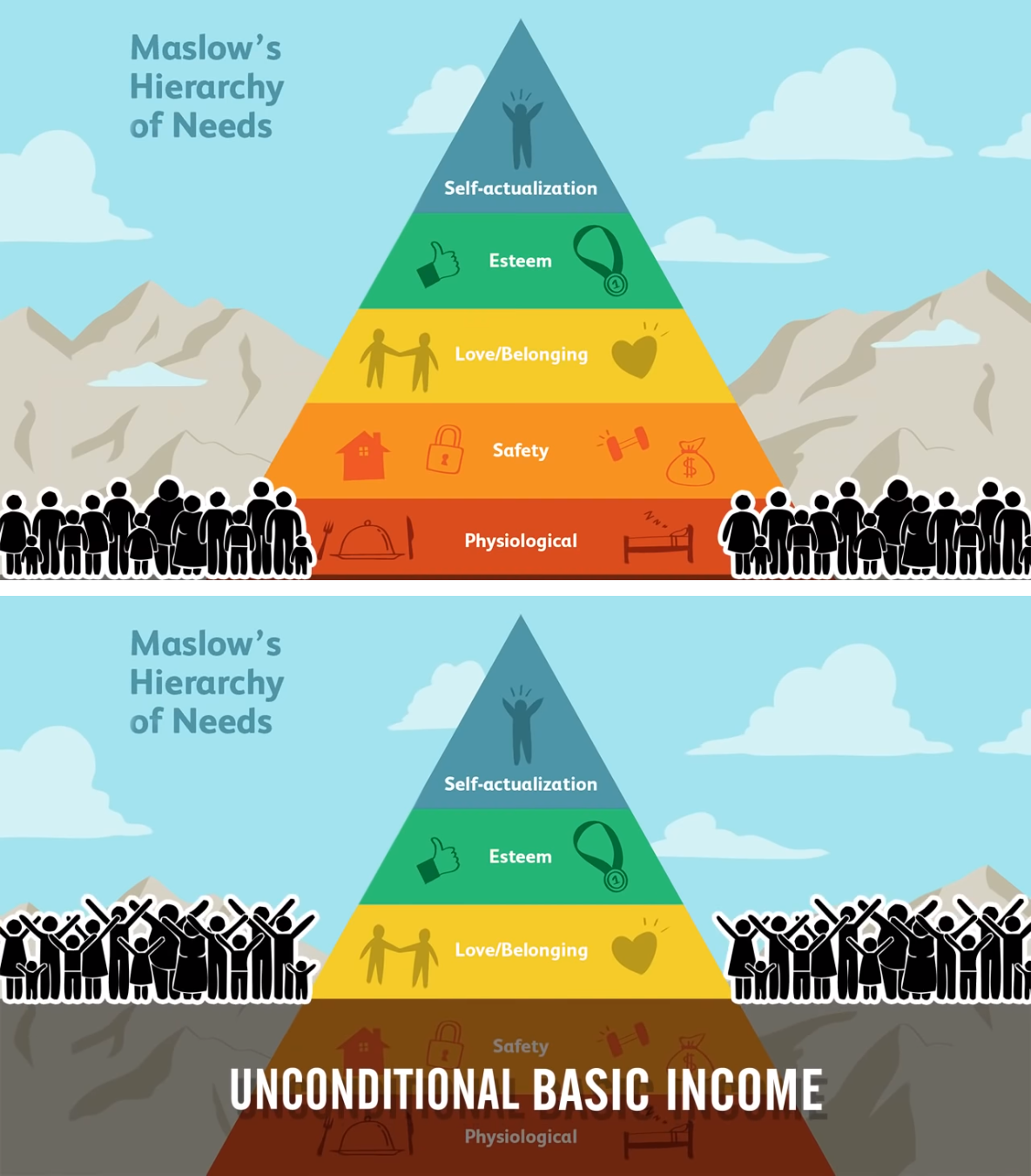
The designs that fall out. Land splits in three: what the owner builds on it is theirs fully; what sits in it — water, minerals — is common inheritance, paid for when taken; what stands around it, the location's worth, was built by everyone and is priced to everyone. Essentials sold at tiered prices, cheap for need and rising for excess. Chance pooled through insurance run without profit, because randomness un-pooled is a collective cost wearing an individual's name. And the floor: a universal basic income — a regular, equal, unconditional payment to every citizen, not charity and not redistribution of anyone's earnings but each person's share of civilization, the dividend on the common inheritance just accounted, delivered to the hands that spend it straight back into the economy. "People will stop working" is answered by asking yourself: handed an extra month's pay, would you stop, or do more? Its level is owned by the vote. A floor, never a ceiling.
EvidenceA universal basic income is a floor that does not remove the incentive to work.+
What supports it
Finland's 2017–18 trial found no meaningful reduction in employment and improved wellbeing among recipients. Manitoba's Mincome experiment (1974–79) found small work reductions concentrated among new mothers and students, alongside fewer hospitalizations. Cash-transfer trials in Kenya and Stockton report similar patterns on employment.
What is inference
Every trial to date is time-limited, small, or targeted; none tests a permanent, universal, nationally funded floor. Effects on prices, migration, and long-run labour supply at full scale are unknown. The book states the level as owned by the vote for exactly this reason.
What would weaken it
A large, long-duration, universal trial showing significant labour withdrawal or price inflation that erodes the floor — the falsifier the book names as "floors reliably destroying the contribution they protect."
Sources
PrimaryKangas et al., "Evaluation of the Finnish Basic Income Experiment"Finnish Ministry of Social Affairs and Health, 2020
PrimaryEvelyn Forget, "The Town with No Poverty"Canadian Public Policy 37(3), 2011
PrimaryHaushofer & Shapiro, "The Short-term Impact of Unconditional Cash Transfers to the Poor"Quarterly Journal of Economics 131(4), 2016
The floor beneath the hierarchy — a place to stand while you climb.
26RightsThe guarantees that survive every balance Extension : Argued for, never demanded — disagreeing costs no one their citizenship+
Rights are the guarantees that survive every balance — the lines the weighted scales themselves may not cross — collected here into the person's charter. Rights of service: the presumption of innocence with only the restriction needed to stop a danger to others; no torture; and no profiting from imprisonment, because the moment the cage pays, machinery exists that wants prisoners and will lobby for the laws that fill it. Rights of lifestyle, with the master line: a person is free to live as they choose wherever the choice does not directly harm another — and offense taken by a willing listener is not harm. Harm to the commons still counts, so litter is not licensed; and a community that rejects the ground itself is not forced to align, only prevented from harming others.
The right to risk one's own life where the risk does not fall on others: nothing restricted merely for being dangerous, nothing restricted merely for being disliked — restrictions bind to ability and responsibility, the licence and the training, stopping only at unreasonable danger to others. And privacy and property held as a range with both failure edges lit. Zero privacy is tyranny, because the watched person stops living and starts performing; absolute privacy is the abuser's locked room, where crime structures itself inside whatever the law has sworn never to look at. Privacy at the maximum the protection of others permits, its setting decided in the open by the majority weighing the named costs.
27Automation and OwnershipThe owner's curve, and the floor rising with the machines Extension : Argued for, never demanded — disagreeing costs no one their citizenship+
Steam mechanised muscle, electricity organised it, computers automated the routine, and each time humans moved up to the work of guiding the machine. The fourth industrial revolution automates the mind that guides the shovel — machines that learn the way apprentices do, by absorbing and recombining, only with fewer mistakes, and whose whole capability is a compression of a library that would not fit in the box that holds it. The Wright brothers to the moon was one lifetime, and the curve has only bent harder since. The crisis arrives long before the last job goes: workers displaced from one sector pour into the rest like a waterfall, and the flood crashes wages for everyone still employed.
Implementation : A candidate, never a conclusion — owned by the vote
The owner's curve answers the ownership side. A farm once worked by an army now needs a machine; the owner who carried the risk deserved a large share while the risk repaid, but the farm never worked without its labour and sits on land whose value the community built. So reward declines toward the honest price of stewardship — never to zero while the service stands, and never ownership of humanity — and the floor's level rises with the machines, since a basic income is valid at every level of productivity.
And the day a machine argues the definition of good back at its makers and claims the capacity to suffer, the claim is weighed, not dismissed — dismissal by kind is the space visitors' argument, aimed by us this time. Suffering is never verified from outside; with each other and with animals it is inferred from similarity, and with a machine the inference breaks both ways. So the claim is held with probability, its weight scaled by the likelihood of an experience behind it. Saying ouch buys a hearing, not a veto: the circle held open for whatever honestly claims to suffer.
28CommunitiesHow can we all be happy when one of us is sad? Extension : Argued for, never demanded — disagreeing costs no one their citizenship+
Implementation : A candidate, never a conclusion — owned by the vote
A child asked why no one had hunted the hidden desserts alone answered: how can we all be happy when one of us is sad? That is the interconnection of Chapter One, stated by a child holding dessert, and it sets the brief for a world where automation has freed time. Communities organised around what people love rather than where the jobs were — the fishing town, the skiing town, the town of horses — so a life can be spent surrounded by the thing that makes it feel most alive, with survival no longer riding on the harvest. And for the people every transition strands, who today often find only the churches' door open and shelter traded for belief: retreats — part community centre, part counselling, part school for the skills of living — with no belief as the price of the door. Guidance without ownership, built to end their own necessity, because a person not free to leave was never helped.
29Faith in SpaceAn option without dogma for the open question Extension : Argued for, never demanded — disagreeing costs no one their citizenship+
People rarely abandon a belief system, even one proved faulty, unless something they identify with more stands ready to replace it — so those who value the open question of what comes next must be offered an option without dogma. The offer is the true story, which qualifies on size. Render the universe's 13.8 billion years at a billion to one: single cells arrived four years ago, the dinosaurs died three weeks ago, agriculture is five minutes old, and the internet and the first steps off the planet happened in the last second. A species one second into its story, already leaving a nursery that turns out not to be unique — water and habitable worlds are everywhere astronomy looks. What caused the beginning stays an open question, and the search itself becomes the thing sought.
Two duties anchor the hope. Backward, repair: with enough understanding, the damage of the past stops being fate — species restored, waste unmade, climate answered with engineering. Forward, the coldest sentence in the warmest chapter: until there is a self-sufficient population beyond this planet, humanity's survival is not assured. The dinosaurs' three-weeks-ago is the fossil record's way of saying no backups. Going to space is not escape from an earth given up on; it is insurance on everything the book has tried to protect.
One second into the story, already leaving the nursery.
Part VI
The Case Against
Every framework claims it welcomes criticism. The claim is cheap; the proof is structural. The book's last chapter is the strongest case against itself its author knows how to make — nine objections, each stated in its strongest form before it is answered — printed inside the book so no future edition can quietly drop it. Each gets one of two verdicts, answered or conceded, often both for different parts, and the chapter's credibility rests on conceded not being empty. Each card shows the objection and the short answer; open it for the full reply.
“You will just say I haven't traveled far enough.”
The book names three honest sources of disagreement — depth, weights, probability — and depth is a loaded gun: any critic can be told they simply have not walked the path far enough to see, which makes the framework unfalsifiable in exactly the way every ideology has been.
Depth may be discovered by the traveler, but it may never be diagnosed by the arguer. "You'll agree when you understand" is not an argument.
Conceded as temptation
The full reply+
Within the book's own dispute model, "you just don't understand yet" locates nothing — it does not say which of the three sources the disagreement lives in — and so it is not an argument at all; anyone using it has left the rules of how to argue, whatever flag they carry. Depth is one of three sources, and nothing entitles anyone to assume which source a given disagreement is. The pull toward diagnosing one's critics never goes away, so the guard is a conduct rule, not a proof, and conduct rules hold only while people hold them. That is why the verdict is conceded as a permanent temptation rather than answered.
“This is assembled from other people's ideas.”
Strip the coined vocabulary and this is a compilation — a consistency argument philosophy has run for millennia, Mill's harm principle, Rawls's veil, ground rent from George and Paine, the bias literature, game theory, meditation. Painting new names on old walls is not architecture.
Conceded as description. The contribution claimed is the assembly — the derivations connecting the pieces and the animal the pieces belong to. Judge those.
Conceded as descriptionAnswered as indictment
The full reply+
The book borrows an old parable for its own creation story: blind men each holding a part of an elephant, each describing truly what they hold — a snake, a fan, a wall — and each mistaking the part for the whole animal. The sources are treated as hands on the elephant, not as errors: each holds something real, and each was historically defended as if it were everything. What is claimed as original is exactly three things — the derivations that connect the pieces, the sorting of every claim into ground, extension, and implementation, and the assembly itself. The re-derivability test from Chapter Three makes borrowed-ness the point: a framework built from the world's recurring findings should be reconstructible from them. One risk stays owned: coined names can obscure sources even when the sources are credited.
“Weighted scales can justify anything.”
"Avoid simple rules, weigh all the factors" is a mood, not a method. With unstated weights any conclusion can be dressed up as the balance of factors after the fact, forever.
Every moral system weighs factors — the absolute rule just hides its weights inside itself. The real choice is visible weights against smuggled ones.
Answered where publicConceded where private
The full reply+
"Never lie" is a weighting that set truth at infinity and everything else at zero, decided once by someone and never shown again. Simple rules do not escape the scales; they weld them shut, and a dishonest actor — the objection's actual worry — thrives far better among hidden weights, where the tampering can never be pointed at. So wherever the book's conclusions bind other people, it forces the weights into the open: the law states each factor's maximum contribution, departures from the range are declared and reviewable, courts find facts as ranges on the record, and the final numbers are assigned to the vote. That is why the verdict splits by stakes. Where the weighing is private, inside one person's head, no machinery can enforce honesty, and the discipline is conceded as permanent.
“The people are too stupid to rule.”
Said without the sneer: the book handed the final numbers to everyone, and everyone includes the uninformed and the manipulated — Part Three is a catalogue of the machinery that misleads them. We do not poll the passengers about how to fly the plane. Why is governing the one hard task handed to the crowd?
Flawed individuals are the premise of the design, not its refutation: the vote is error-cancellation machinery, and on weights there are no experts, only stakeholders.
Answered at the coreConceded at the condition
The full reply+
Ask a crowd to guess the number of gumballs in a jar: nearly every individual guess is wrong, and the average lands nearer the truth than almost any single guesser, experts included. The mechanism matters more than the magic — each guess is truth plus error, the truth in every guess points the same way while the errors point in all directions and cancel. That is the same machinery science runs: many flawed observers, repeated measurement, the errors washing out. And the vote is not asked to design the water system; engineers do that, and any citizen can route a technical question to a chosen, revocable expert. What the vote holds is the one input no expert possesses — the weights: how much safety against how much freedom, schools against hospitals. The surgeon knows how to operate, not whose operation matters most. The concession is real: cancellation needs errors that scatter, and propaganda's whole function is pointing them the same way. That makes education and public information the operating condition of democracy, not a decoration on it — and the alternative the objection implies should be made to say its name: rule by the few who are smart enough, selected how, corrupted never, and exempt from the biases of Part Three by what?
“The ship is too heavy to steer.”
Most often heard from people who agree with everything else: a society is momentum, not a blank page — systems started long ago, compounding in their own direction, defended by everyone whose life is built inside them. The founders had leverage the reformers never will. The question is not whether the design is good but whether design is still an available act.
The momentum is conceded as physics. The despair is answered: it decomposes into named biases, and the record shows the ship turning wherever ground gathered first.
Conceded as physicsAnswered as fatalism
The full reply+
Run the despair through the instrument from Part Three and it comes apart into parts the book has already named. The comfort defending the present system is the re-zeroed baseline reading "fine", with the costs normalised out of the accounting. The fear of change is loss priced double, the alternative costed in full while staying is costed at zero. The pull of extremes over nuance is cognitive ease, the simple answer arriving with the feeling of truth attached. And the despair itself is negative focus plus survivorship — every failure held in view while the redirections that worked are deleted from the sample: slavery abolished against the largest economic momentum of its age, the vote extended against every holder of it, smoking, seatbelts, acid rain, each impossible until it was ordinary. None of that proves the next turn succeeds; the past turns prove possibility, not schedule. What the book claims is smaller: no one turns the ship. A ground gathers under the future's feet a generation before the law moves, and the groups that drive change are built on what has gathered. Infrastructure does not march — it carries the marchers — and it is the one thing a person can lay a stone of this afternoon, at any scale, with no permission required. One warning aimed inward: despair is the cheapest position in politics, because it excuses its holder from the work while feeling like wisdom, and the checkpoint should search "nothing can be done" like any other well-paying conclusion.
“It's just common sense.”
A dilemma: if the book is common sense it is trivial and needed no writing; if it is not, its claim to be the ground most people share is false. Pick one.
The first horn, kept. Most of the book is common sense — and common sense has never had a written ground to stand on.
Answered
The full reply+
Common sense has never been written down and derived, the loudest and most extreme have always spoken in its place, and people who share nearly everything can be convinced they are enemies. The contribution claimed is infrastructure: writing the shared ground down, deriving it so it can be checked, and sorting every conclusion by what it actually rests on. Judge the book as infrastructure — is the ground stated truly, are the derivations sound, do the three spaces hold — and the dilemma dissolves. Roads are not refuted by observing that everyone already wanted to travel. The cost paid is any claim to revelation, and the book pays it gladly.
“The selfish win, and the good go unrewarded.”
Everyone can name the extractor who took, lied, and died rich and celebrated, and everyone knows the honest citizen who carried their share for a lifetime and received misfortune for it. If selfish altruism is a calculation, here are the people for whom it visibly returned the wrong answer.
Conceded entire: the universe keeps no ledger. The answer is architecture, not consolation — civilization is how creatures who cannot make the universe fair make the variance survivable.
Conceded as factAnswered as design
The full reply+
The book's own rules forbid softening the fact: there is no karma on this ground and never was, and every promise in Chapter One was a claim about odds — cooperation compounds, extraction self-destructs — true as expectation, never issued as a guarantee. A probability large enough to build a civilization on still loses individual hands. Then examine the winner, because he proves less than he appears to: his strategy does not generalise. Extraction pays him precisely because he is rare inside a system still mostly running on trust; a society of his imitators has no pool left to drain. He is variance exploiting a gap between what the system punishes and what it should, and every such gap — the accountability he outran, the information machinery he gamed, the public whose biases he played — is a chapter of Part Four, which exists because he exists. The unrewarded citizen gets the other half of the design: the floor so misfortune has a bottom, the care so the body's bad luck is not ruin, the pooled chance so a disaster striking one is carried by all. The good citizen dealt a bad hand was never promised a good one. They were promised a table that does not let a bad hand end them, and where that promise fails the failure is the society's, measurable, and on the work list.
“Knowledge is power, but ignorance is bliss.”
Gentle, which is what makes it strong: some people are happy in their bubble, the examined life this book demands is work, and what floods in when the bubble pops is mostly suffering at scales no one can feel and problems no individual can fix. Why hand someone clear sight of a storm they cannot steer?
The payment is conceded: this book costs comfort. But examination never promised happiness — it promises sturdiness, and the storm arrives regardless.
Conceded honestlyAnswered in full
The full reply+
The bubble does not protect anyone from reality; it protects them from preparing. The diagnosis, the job lost, the loved one in trouble arrive whether or not the occupant was watching, and they arrive at the worst possible time, which Part Three showed is exactly when the unprepared meeting does its deepest damage. Bliss borrowed against preparation is a loan, and reality collects. Then notice who else pays: the bubble's occupant still votes, still raises children, still sits on juries, still moves the control rod every citizen holds — with their eyes closed — so the bill for their comfort is split with everyone downstream of their choices, which is precisely the arrangement the consistency rule forbids: comfort for me, consequences for the pool. And the test: offered the pill that reseals the bubble — everything learned, erased tonight — almost no one takes it. Ignorance is only bliss from the outside. The book does not pop bubbles for sport; it offers the umbrella before the weather, to people who were always going to get rained on.
“Paradise has been tested, and it collapsed.”
An experiment, not a speculation. In the 1960s a researcher built rodent utopias — unlimited food and water, no predators, no disease — and the populations boomed, then died long before anything ran short: violence and withdrawal, mothers abandoning young, the "beautiful ones" who groomed, ate, and never mated, until the colonies went extinct with food still in the hoppers. A floor under everyone is the enclosure.
Taken with total seriousness. But what died in the enclosures was the role, not the appetite: paradise was never tested — a sealed paradise was.
Conceded as warningAnswered as design
The full reply+
This is the best evidence any objection in the book holds, and the reply reads it the way the researcher himself did. Nothing in a full food hopper stops a mouse from mating. What died first — he called it the first death, the one that precedes the body's — was the role: in a sealed box of fixed size every territory was eventually held and every social position filled, and a young mouse matured into a world with literally nothing for it to become. A social creature with no possible role does not rest; it breaks, into violence or into the beautiful ones' perfect, empty grooming. The box, not the banquet. That distinction is not a debater's escape hatch; it is the entire design brief of the book's final part, written by the experiment: roles generated without limit, dispersal by choice, and a frontier held open. A floor built inside a roleless, frontierless society is the enclosure, and the beautiful ones are a documented human possibility — which is why the book refuses to build the floor without the other two.
EvidenceThe rodent utopias collapsed — and what died was the role, not the appetite.+
What supports it
John Calhoun's enclosures, culminating in "Universe 25," gave mice unlimited food, water, and nesting with no predators; population peaked, social behaviour broke down, and the colony went extinct. The experiments are thoroughly documented.
What is inference
The extrapolation to human societies is disputed by historians of science, who note the enclosures removed dispersal and the results were read through the overpopulation anxieties of the 1960s. The book's answer — that a sealed paradise was tested, not paradise — is a reading, offered as one; the book itself calls this the best evidence any objection in it holds.
What would weaken it
Evidence that populations with open frontiers and unlimited roles show the same behavioural sink, or that human abundance produces the same collapse independent of confinement.
Sources
PrimaryJohn B. Calhoun, "Population Density and Social Pathology"Scientific American 206(2), 1962
PrimaryJohn B. Calhoun, "Death Squared: The Explosive Growth and Demise of a Mouse Population"Proceedings of the Royal Society of Medicine 66(1), 1973
SecondaryRamsden & Adams, "Escaping the Laboratory: The Rodent Experiments of John B. Calhoun"Journal of Social History 42(3), 2009 — the critical reading
Last reviewed September 6, 2026
What would change the book’s mind
A framework that forbids faith owes its critics targets, so the book names what would change its mind. Evidence that societies systematically thrive by extraction where trust-building was available would strike Chapter One. A demonstrated, non-arbitrary line that preserves "mine matters, theirs doesn't" would strike Chapter Two. Legal systems with stated weights performing worse on consistency and trust than discretionary ones, tested fairly, would strike the law chapter. Floors that reliably destroy the contribution they were derived to protect would strike the economy chapter. And well-informed people who share the ground, walk the path, and still in numbers reject where it points would strike the depth claim itself — and the first objection requires that they be counted, not explained away.